



GRC documents risk. AI governance reduces it.
Platforms like OneTrust, ServiceNow, and Archer organize and document risk. They were not built to validate AI controls or reduce risk in production. Monitaur is the AI governance software that goes beyond GRC: it validates controls and measures residual risk reduction at runtime, across every project in your portfolio.
Book a 30-minute walkthrough. See how Monitaur validates AI controls and measures residual risk reduction across your portfolio.
You have a GRC platform. That isn't the same as AI governance.
A GRC platform organizes policies, logs risks, and stores documentation. That work matters, but documentation is not governance. It does not test whether a model behaves as intended, validate that controls operate, or measure the risk that remains after they do.
AI compliance is decided in production, not in a policy library. When an auditor asks how a specific decision was made, by which model version, under which controls, a documented policy does not answer. Validated, evidenced controls do.
Beyond GRC: from documenting risk to reducing it.
GRC platforms were built to organize risk across the enterprise. Monitaur was built to reduce it where AI operates. The platform validates controls automatically, guides teams to risk-reducing actions, and measures residual risk at runtime. That's the difference between a record of your risk and a reduction of it.
Reduce risk, don't just document it.
Monitaur validates that controls operate, tests how models behave, and measures the residual risk that remains. Your GRC platform keeps the record. Monitaur changes the number.
Automated AI governance, from policy to production.
Implementing AI governance through manual GRC workflows does not keep pace with AI. Monitaur automates the path from policy to production: control libraries, evidence capture, and validation that run continuously, so governance keeps up with every model you deploy.
A visionary approach to AI governance
Monitaur is an AI governance company built on a visionary idea: that trust in AI comes from validated controls and measurable risk reduction, not paperwork. The platform earns recognition from the forward-looking analysts that enterprises rely on.
You have a GRC platform. That isn't the same as AI governance.
A GRC platform organizes policies, logs risks, and stores documentation. That work matters, but documentation is not governance. It does not test whether a model behaves as intended, validate that controls operate, or measure the risk that remains after they do.
AI compliance is decided in production, not in a policy library. When an auditor asks how a specific decision was made, by which model version, under which controls, a documented policy does not answer. Validated, evidenced controls do.
AI inventory & catalog
Centralized visibility into every AI system across your organization, including third-party and vendor-embedded models operating across business units and geographies.
Model explainability and bias detection
Understand how models make decisions and identify bias before they create regulatory or reputational exposure, with the transparency that auditors and stakeholders require at scale.
Risk assessment & management
Structured risk workflows pre-mapped to regulatory requirements and ready to scale across the enterprise without manual rework.
Automated policy compliance
Control libraries that map to EU AI Act, ISO 42001, NIST AI RMF, OCC, SOX, HIPAA, NAIC, and FFIEC. Map once, govern at scale across every market you operate in.
Pre-deployment assurance
Connect to your model infrastructure through APIs and libraries. Validate models before they go live, so deployment stays fast and defensible.
Runtime validation & continuous monitoring
Real-time visibility into model validation and performance across your portfolio, built for governance accountability rather than retrofitted from MLOps tooling.
One platform. Every model type. Beyond documentation. AI policy defines risk. Controls mitigate it.
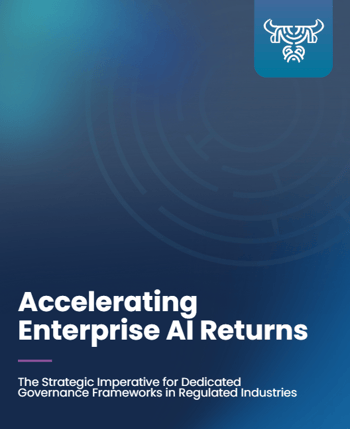
The guide for risk leaders rethinking AI governance.
Accelerating Enterprise AI Returns lays out why documenting risk is not the same as reducing it, and what separates AI governance that scales from governance that stalls.
What's inside:
- The five operational distractions that derail AI programs, including the organizing-is-governance fallacy
- How proactive governance converts compliance work into margin
- A build versus buy framework, plus a five-question self-assessment for your own program

Enterprise-proven. Globally recognized.
Regulated enterprises reach full governance implementation in under 90 days, grow governed AI projects 8x, and realize millions in efficiency gains. Governance becomes the engine of AI growth, measured where it counts.
Fortune 200 financial services company
Scaled AI projects while reducing risk exposure
Insurance carrier
Full governance implementation and measurable ROI in under 90 days
Recognized by industry analysts

Gartner Market Guide for AI Governance Platforms: Representative Vendor

The Forrester Wave™: AI Governance Solutions, Q3 2025: Customer Favorite

Chartis AI Governance, 2025: Category Leader

FinTech Global InsurTech100 for 2025
Start with a conversation not a commitment.
Wherever your AI governance program stands today, from first policy to hundreds of projects in production, a short conversation is the clearest way to see what Monitaur would change for your velocity and your return. Bring your current approach and your open questions. You'll leave with insight into where your controls are working, where the gaps might be, and what it would take to close them.
Monitaur is the only customer favorite, category leader, and visionary in the market, according to analysts. Schedule time with the team that's leading the way in AI governance.